Gender Intelligence Report 2022 – for the first time with an industry focus
September 14, 2022
Everyone is talking about the shortage of skilled labor. But is there really such a shortage of talent, or rather a shortage of talent management in Switzerland? This is the question the latest Gender Intelligence Report Gender Intelligence Report explores. The annual report is now in its sixth year and is published jointly by Advance, the leading business association for gender equality in Switzerland, and the Competence Centre for Diversity and Inclusion (CCDI) at the University of St.Gallen. A look at the different industries reveals that some make much better use of the existing female potential than others. Another discovery: the glass ceiling has a lot to do with Swiss culture.
There is a key question companies should ask themselves, especially in times of a shortage of skilled labor: Do we really not have enough talent, or are we not making enough of the existing talent potential – especially that of well-educated women? For the first time, this year’s report includes an industry comparison that brings to light substantial differences in how various sectors retain, develop, and promote women to senior management levels.
The report uses the Glass Ceiling Index (GCI) as a metric for this. This index shows whether men and women are equally represented at management levels — or whether one gender is under- or over-represented. In addition, the raw HR data is analyzed for differences in the level of education and the distribution of so-called “power positions” (positions with influence and decision-making responsibility). The report explores patterns around these factors, identifies reasons for the leaks in the female leadership pipeline and derives actionable measures for improvement.
+3 percentage points increase in the share of women in management positions since 2020
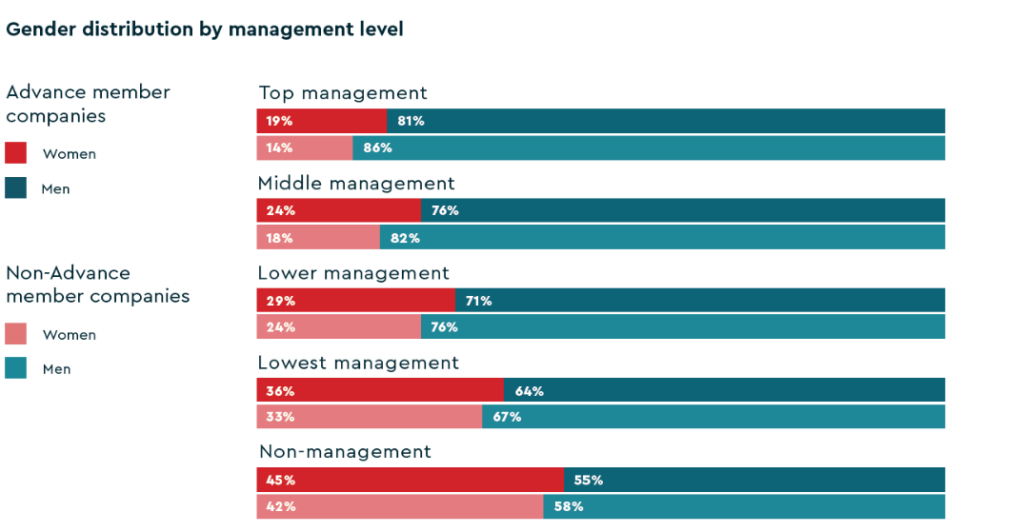
Overall, the share of women in management positions has increased by only 3 percentage points (2020-2022). Notable fact: Companies that have been making a conscious effort to improve gender diversity for years show significantly better results. For example, Advance member companies have 24% women in middle management, while non-member companies only achieve 18%; in top management it is 19% vs. only 14%. In other words: Advance members commit to actively promote the issue, and it shows.
Gender distribution by management level Advance- vs. non-Advance members
A question of corporate culture
It is the companies that have anchored diversity and, above all, inclusion both in the corporate strategy and in the individual goals of managers that achieve the best results, i.e. the thinnest glass ceiling. These kinds of measures seem to create a corporate culture in which women thrive and develop their potential.
MEM and Pharma/Med-tech industries among the best-in-class
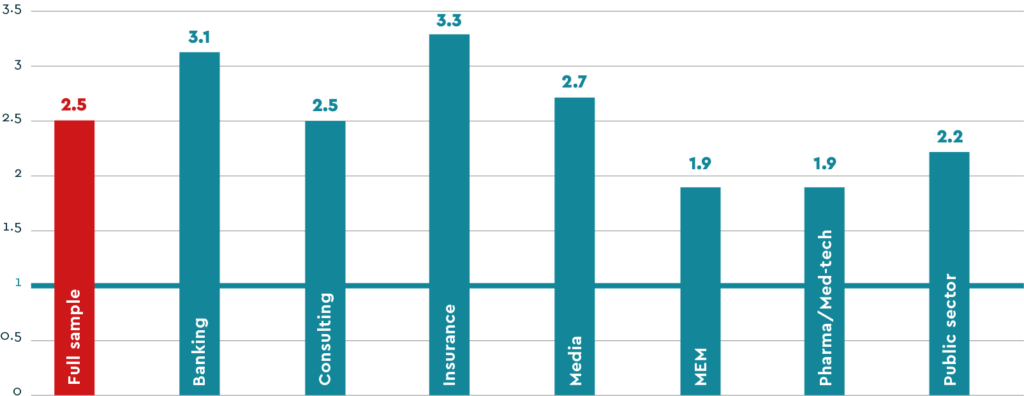
No industry has yet shattered the glass ceiling, that is, achieved a Glass Ceiling Index of 1, i.e. equal representation along the hierarchy levels. However, the Machinery, Electrical and Metal industry (MEM) and the Pharmaceutical/Medical technology sector stand out together with a respective index of 1.9. Insurance and Banking, on the other hand, fare the worst with an index of 3.3 and 3.1.
Surprisingly, the industry that traditionally attracts the fewest women is making the most of its female talent potential (MEM). This may be due to the fact that there is hardly any discrepancy in the level of education between women and men in the MEM and Pharma/Med-tech sectors. The situation is different in the Insurance industry: here there is a difference of 9 percentage points in the tertiary qualifications of women and men in in non-management in the age group up to 30, while there is already equality of education across the entire sample in this age group. For management positions, a tertiary degree is the norm.
Glass Ceiling Index for middle/top management by industry
In the Media industry, women in the talent pipeline are slightly better educated than their male counterparts: In non-management, 65% of women have a tertiary degree, compared to 63% of men. One of the reasons for the low share of women (21%) in top management (vs. 53% women in non-management) may be the high rate of women working part-time (51%). Part-time seems to be feasible up to the lower management levels, whereas full-time is the norm in the upper management levels. The Media sector has a glass ceiling index of 2.7, which is slightly worse than the average of 2.5.
Power imbalance remains virtually unchanged
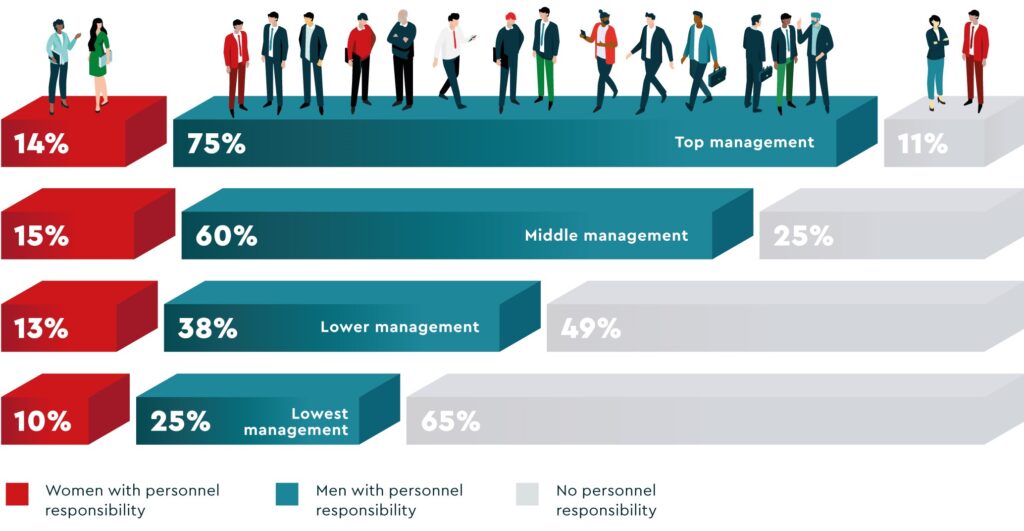
The power imbalance between the genders still looms large: positions with influence (personnel and budget responsibility) are largely in male hands – also within the respective management levels. 75% of all positions with personnel responsibility in top management are held by men.
Personnel responsibility by gender and management level
Swiss culture as a stumbling block: 3.5 times greater leakage among Swiss women
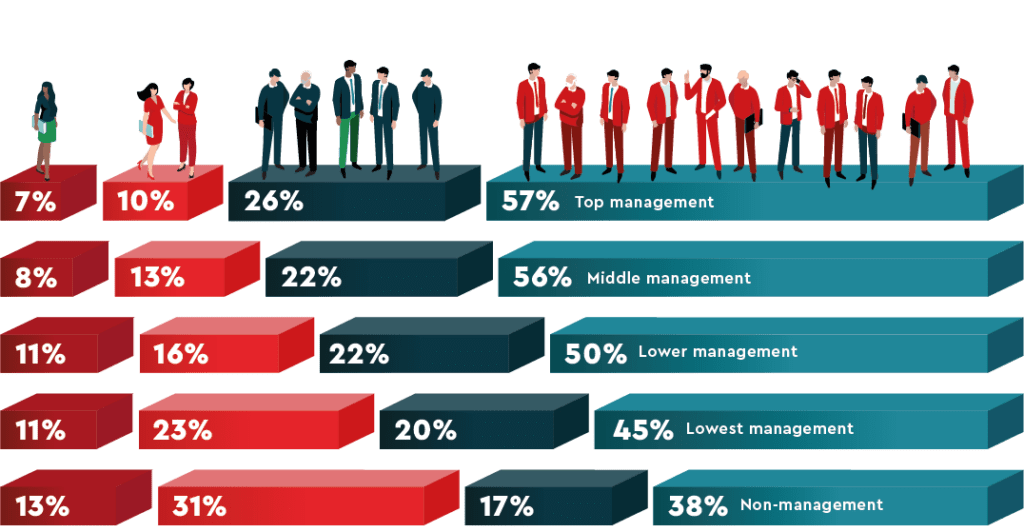
The analysis shows that the more Swiss an industry is (measured by the share of Swiss employees), the less gender-diverse it is or the thicker the glass ceiling. This suggests that the Swiss culture still has a hard time taking women’s careers for granted. One result stands out: the leakage in the female leadership pipeline is 3.5 times bigger for Swiss women than for non-Swiss women. Specifically, the representation of Swiss women shrinks by 21 percentage points (from 31% to 10%) from non-management to top management, compared to 6 percentage points for non-Swiss women (from 13% to 7%). What is behind this? On the one hand, the widespread part-time culture among Swiss women, but then also the still gender-separated career paths and, finally, the costly and difficult reconciliation of career and other important life aspects such as child care.
Representation of gender and nationality by management level
Employment rate and financial equality as a prerequisite
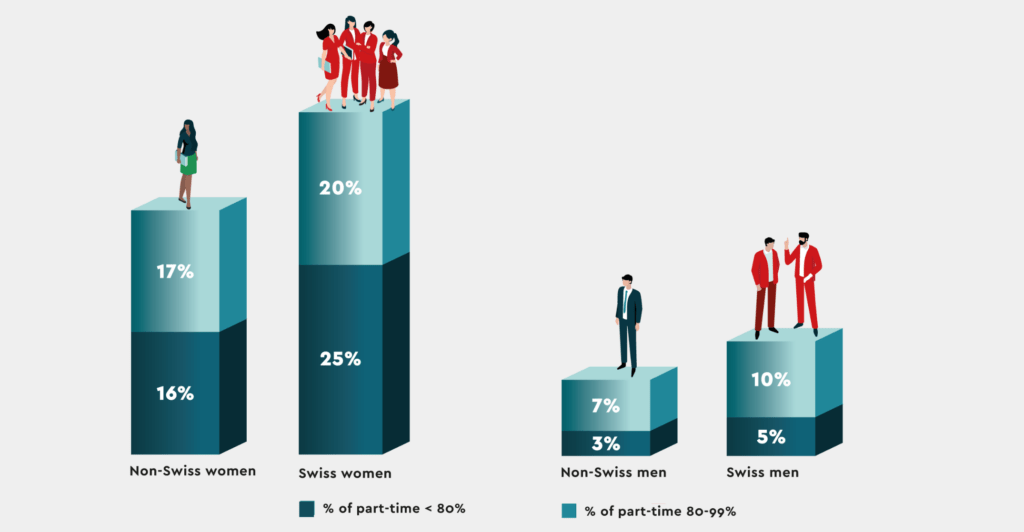
As long as the majority of women still work part-time and men take on the role of the primary breadwinner, little will change in the existing power imbalance. This continues through all phases of life all the way to retirement, when women face significant pension gaps. Employment rate and financial equality are therefore just as relevant as partnership models in the family to realize actual gender equality.
Part-time according to gender and nationality
20 or 100 years until parity?
Apart from sobering findings, this year’s Gender Intelligence Report shows one thing above all: It can be done! If all industries recruited and promoted as many women to management positions as the MEM industry does, we could achieve gender parity in Switzerland in as little as 20 (!) years, and thus also confront the (female) shortage of skilled workers. If we carry on as before, however, it will take another 100 years. In other words: Gender equality is in our hands. By the way, those who are interested in finding out what the best sectors are doing differently from the others, will find a practical list of proven success factors in the report. This means that myths like “women don’t actually want to take on leadership positions” are firmly a thing of the past.
Report launched with a Fulminant campaign
The publication of the report is accompanied by a campaign. It aims to raise awareness among managers and decision-makers that the potential of well-educated women is far from being exhausted and to inspire them to take the right steps to change this. The campaign will run from mid-September until the end of October in social media.
LET’s break the glass ceiling together!
If you want to share the campaign, you can use the campaign video link here. Please tag us at @Advance – Gender Equality. Thank you!
The Swiss news programme 10vor10 as well as the Tagesanzeiger and other major titles have already picked up on the report. Special attention is paid to cultural aspects as one of the reasons for the modest progress in gender diversity in Swiss business. Click below for the article in the Tagesanzeiger by Edith Hollenstein, who interviewed Florence Schnydrig Moser. Florence Schydrig Moser is Head of Private Banking at the Zürcher Kantonalbank and on the board of Advance. “Karrierechancen für Frauen” – Tagesanzeiger-Artikel
About the Gender Intelligence Report
This is the sixth edition of the annual report, a collaboration between Advance, the leading business association for gender equality in Switzerland, and the Competence Centre for Diversity & Inclusion at the University of St. Gallen under the co-leadership of Prof. Dr. Gudrun Sander and Dr. Ines Hartmann. The analysis is based on anonymized raw HR data from over 385,000 employees from 104 companies and organizations in Switzerland (equivalent to over 7% of the working Swiss population). The full report can be found here
Media contact for further information Alexandra Rhiner, Communication Manager Advance, alexandra.rhiner@weadvance.ch, Tel. 076 332 85 83
About Advance
Advance is the leading business association for gender equality in Switzerland with 137 corporate members. Advance actively campaigns for more women in management. It is proven that mixed teams make better decisions, are more innovative and usually more profitable. With a concrete program, Advance supports companies in translating diversity into competitive advantages. Because a gender-equal workplace is a win-win for men, women, companies and society as a whole. Advance has set itself the goal of achieving a sustainable minimum of 30% female representation at all management levels across all member companies by 2030.
The Competence Centre for Diversity & Inclusion (CCDI) is one of the leading research institutes in the field of Diversity & Inclusion (D&I) in Switzerland. It offers organizations benchmarking, targeted support, advice and training to strengthen and manage D&I internally. The team has more than twenty years of experience in this field.
Welche Rahmenbedingungen braucht Elternschaft in der heutigen Zeit? Das neuste Whitepaper von Advance und McKinsey belegt mit Daten und Fakten, wie nicht nur Mütter, sondern auch Väter sowie die Wirtschaft und Gesellschaft insgesamt von einem Umdenken in Sachen Kinderbetreuung profitieren können.
Over 250 mentees and mentors gathered at SIX to celebrate the successful closing of the mentoring wave 2023/24 and the new 2024/25 kick-off. We are deeply impressed by the event's spirit and the mentor-mentee pairs' dedication to the program! Visit the gallery and check out our key takeaways from the Summit 2024.
Frau und Macht: ist das kompatibel? Im Video #SwitchOnYourPower lassen wir sechs Frauen zu Wort kommen, die in der Schweiz eine Top-Position einnehmen. Sie räumen mit Vorurteilen auf und laden ein, die positiven Seiten von Macht und Verantwortung zu entdecken.
Cookies are not just tasty, they are also important for us to deliver you the best possible user experience. Therefore, this website uses cookies. By clicking on Ok you accept our use of
cookies and data privacy policy.
We wish you a valuable experience on our website!